Skip to content

Projects

A published research project, open source tooling, and personal and academic builds.

★

Multi-agent RAG for vulnerability detection and repair

Published research, ICCCT 2025

Specialised LLM agents find and fix C and C++ vulnerabilities, grounded by retrieval over MITRE's Top 25 CWEs. 60.71% more correct detection and repair than a single-LLM baseline.

Built with
Gemini 1.5 Flash, ChromaDB, all-MiniLM-L6-v2
Multi-agent RAG framework for vulnerability detection and repair C and C++ source goes through three LLM agents in turn: attack vector identification, vulnerability detection and remediation. The loop repeats until no vulnerabilities remain or an attempt limit is reached, then outputs patched code. Detection and remediation retrieve context from a ChromaDB store built from MITRE's Top 25 CWEs. Source codeC and C++ Attack vector agentfinds potential weaknesses Detection agentconfirms a specific CWE Remediation agentwrites the secure fix Patchedcode repeat until no vulnerabilities remain or the attempt limit is reached MITRE Top 25 CWEsdescriptions, mitigations, examples Embedding modelall-MiniLM-L6-v2 ChromaDBvector knowledge base retrieved context groundsdetection and repair Agents run on Gemini 1.5 Flash; structured JSON output is validated at each step.
Framework overview, redrawn from the paper's method: three LLM agents in a repair loop, grounded by retrieval over MITRE's Top 25 CWEs.
  • LLM agents
  • RAG
  • Security
  • Python
01

universalMods

Open source, MIT licensed

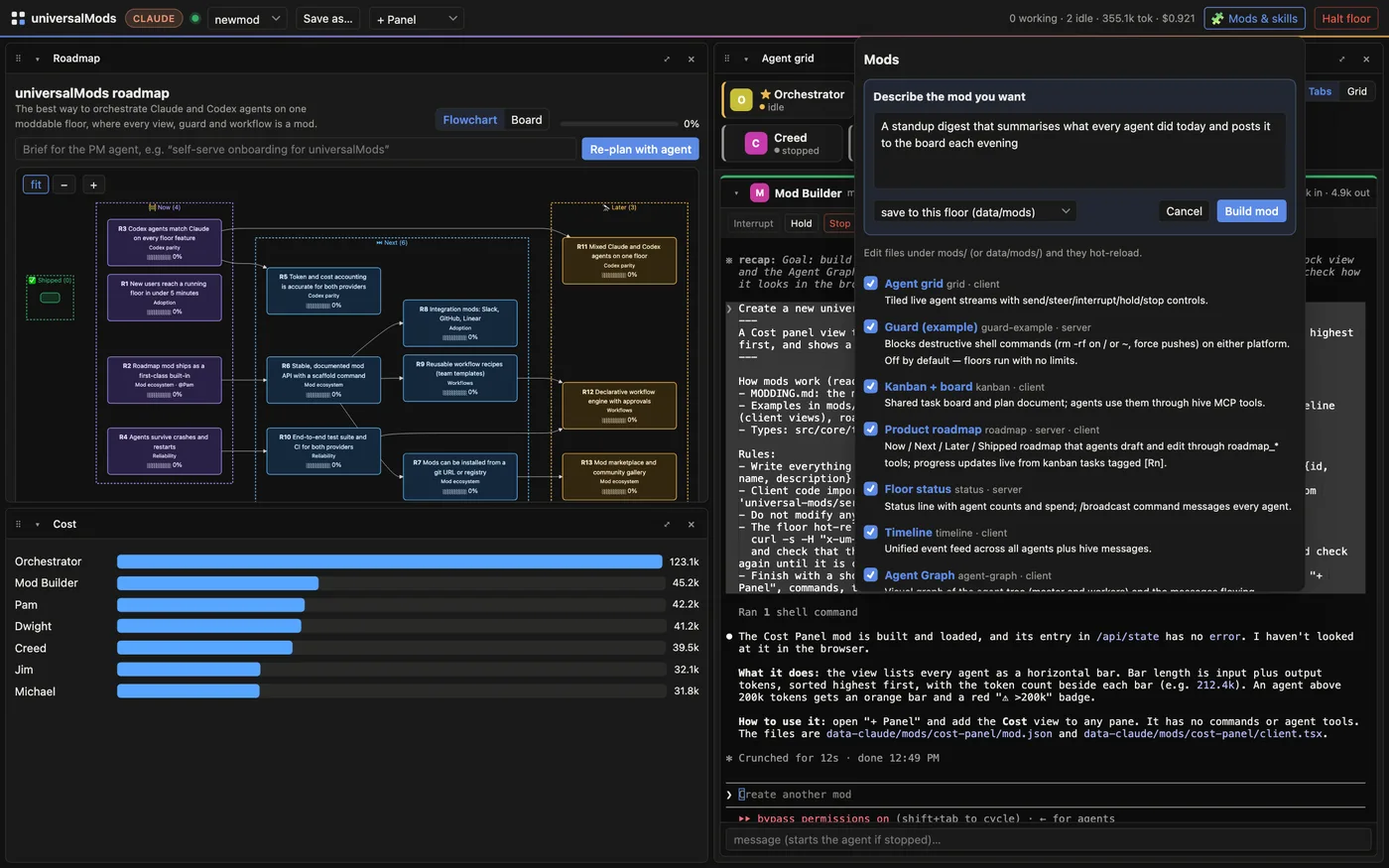
universalMods floor showing a roadmap flowchart, a cost panel and the Mod Builder creating a new mod

A local web floor where a master Orchestrator plans work and delegates it to Codex or Claude Code agents. Each agent runs its real CLI in a live terminal, alongside a shared kanban and plan board, inter-agent messaging and a live roadmap drafted by a PM agent as a Mermaid flowchart.

Everything is a mod: views, guards and workflows are hot-reloading folders with a manifest and server and client halves, and a Mod Builder agent can write one from a single sentence. Guards can deny dangerous tool calls, and the server binds to 127.0.0.1 behind a per-run token.

Agents
Codex via app-server JSON-RPC; Claude Code via stream-json
Built with
Node 20+, TypeScript server mods, React views, Mermaid
Status
Open source under MIT, with a Claude Code plugin install
  • Node.js
  • TypeScript
  • React
  • MCP
  • Codex
  • Claude Code
02

GenieTest

Test automation, QE tooling

Cursor alone has no project-specific context, cannot control what it asks the user, and is unreliable on large repositories. GenieTest closes those gaps with a custom MCP server, Cursor rules for prompt engineering, a Cursor extension and a purpose-built RAG dataset, so QE engineers get test automation scripts faster.

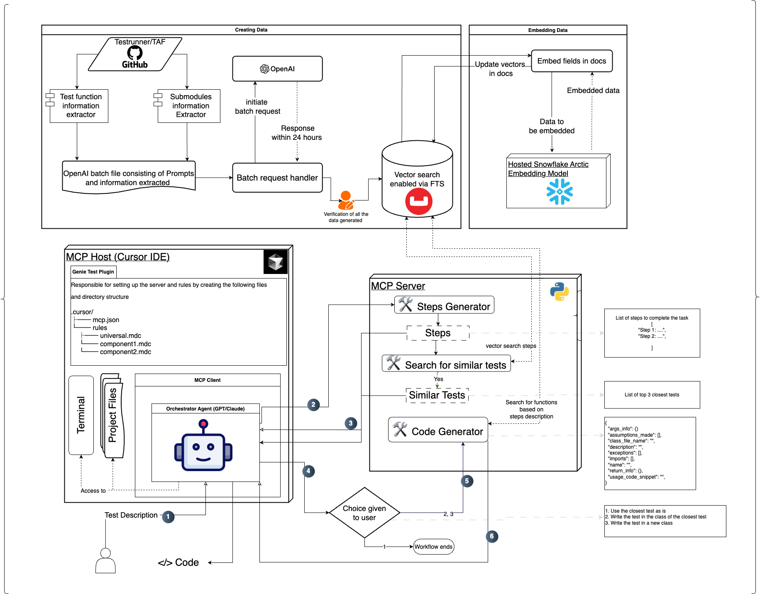
The data pipeline chunks the team's test repositories into a test functions database (description, steps, dependencies) and a helper functions database (usage patterns). OpenAI's Batch API did the initial extraction, the output was quality-checked by hand, and embeddings come from a hosted Snowflake Arctic model.

The MCP server exposes the tools: a steps generator breaks the request into structured steps, the user reviews them, a vector search finds the closest existing test, and a code generator then reuses that test, or writes a new test in the same or a new class, pulling helper functions per step. A review and edit tool does the same for changes to an existing test.

Tools
Steps generator, display steps, closest test, code generator, review and edit
Retrieval
Vector search over test and helper function databases
Host
Cursor IDE with MCP client and Cursor rules
Built with
Python MCP server, Snowflake Arctic embeddings, OpenAI Batch API
GenieTest architecture: a data pipeline builds vector databases from test repositories, and a Python MCP server with tools for steps, similar tests and code generation serves the Cursor IDE host
Architecture: the data pipeline (top) builds the vector databases; the MCP server (right) serves Cursor, the MCP host (left).
  • MCP
  • RAG
  • Cursor
  • Snowflake Arctic
  • OpenAI Batch API
  • Python
03

GOSniff

Personal project

Captures packets with the network interface in promiscuous mode and streams them to a web interface over WebSocket for real-time inspection.

For each packet it reports the protocol (by OSI layer and port), source and destination IP addresses, and source and destination MAC addresses where applicable. Useful for protocol debugging, security monitoring and teaching how traffic moves.

Built with
Go, promiscuous-mode capture, WebSocket, browser UI
  • Go
  • WebSocket
  • Networking
04

Early Speed Breaker Detection

National hackathon, top 10 of 75 teams

Road accidents from speed breakers and potholes cause around nine deaths a day. Smartphone accelerometer and location data feed a TensorFlow RNN that classifies speed breakers, potholes and normal road. Because no public dataset existed, we built a custom one.

A hazard is only confirmed when several devices agree at the same coordinates, which keeps false positives down. Confirmed locations build a live hazard map, and drivers approaching one get an advance alert.

Result
About 80% classification accuracy; top 10 of 75 teams
Built with
TensorFlow RNN, Django, JavaScript client, geospatial database
  • TensorFlow
  • RNN
  • Django
  • IoT
05

Pay via Fingerprint

Computer architecture course

Students pay on campus with a fingerprint and settle later on a tab, a model modelled on the one used at BITS Pilani Hyderabad. A Raspberry Pi with a fingerprint sensor authenticates the user, a Flask REST API processes transactions and MongoDB stores users and transaction history.

Built with
Flask REST API, MongoDB, Raspberry Pi, fingerprint sensor
  • Flask
  • MongoDB
  • Raspberry Pi
06

Mock Stock Trading

Personal project, built before AI coding tools

NOT vibecoded

Practise trading with virtual currency and no financial risk. Free API keys rarely offer real-time data, so the simulator replays historical market data, with portfolio management and performance tracking.

It was the project where I learned how a whole application fits together: serving data, handling user actions, keeping state and showing it back in a usable interface.

How it was built
By hand, from docs, Stack Overflow and YouTube tutorials
Features
Buy and sell orders, portfolios, trade history, performance tracking
What it taught me
Full stack development, end to end
  • Full stack
  • Historical market data